
AI visibility
See which brand AI answers name most
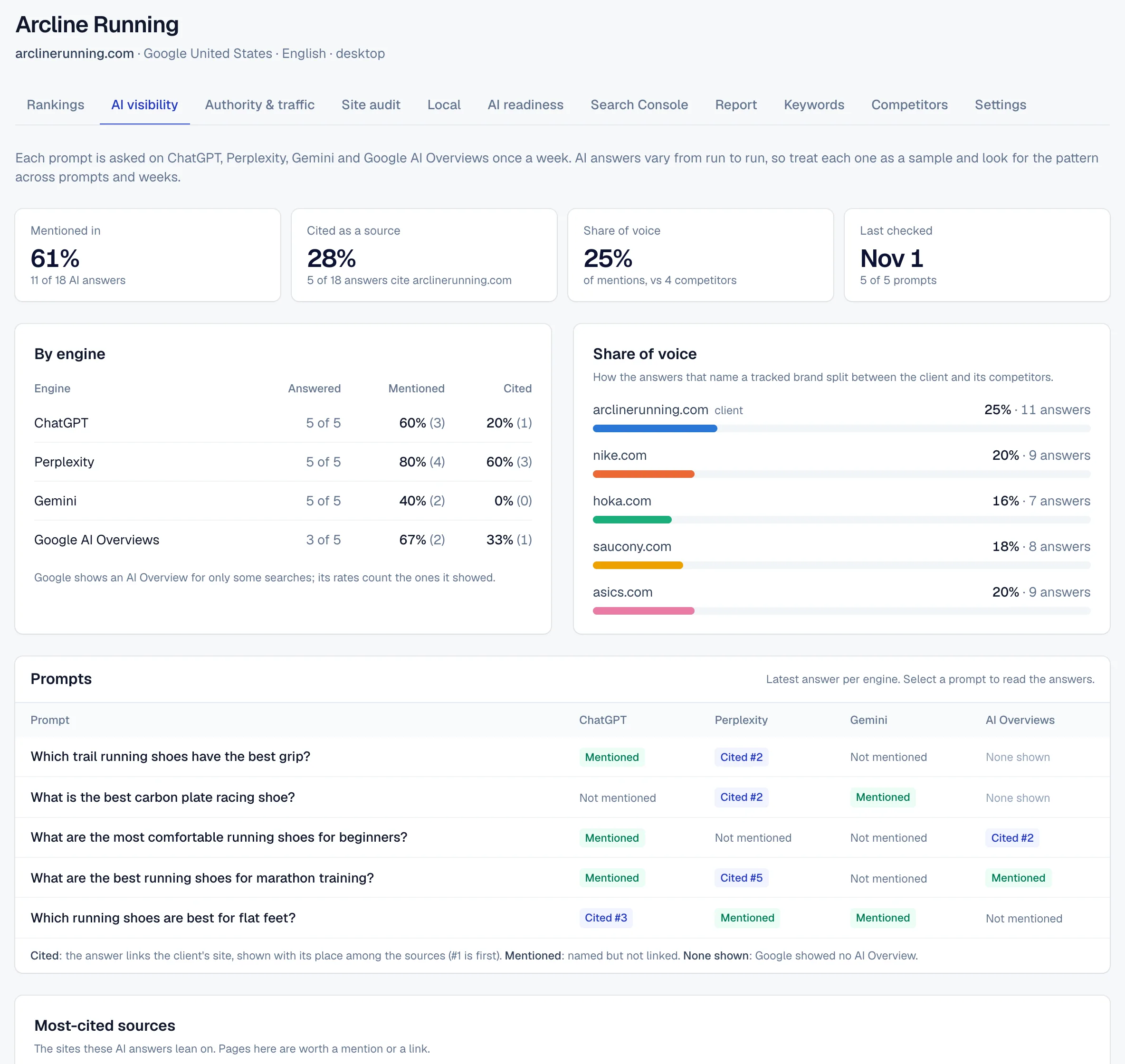
Every week, your prompts go to ChatGPT, Perplexity, Gemini and Google AI Overviews. Share of voice shows how the mentions split between your client and up to 5 competitors.
14-day trial with Agency plan limits · No credit card
The basics
What AI share of voice measures
Share of voice began as an advertising measure: a brand's part of all the attention in its market. In AI search it's narrower and easier to count. Ask the questions a buyer might put to an AI assistant, then count how often each brand is named in the answers.
It matters because an AI answer often names only a few options. A buyer who asks for the best emergency dentist nearby may read three names and call one of them. If a competitor is named in most of those answers and your client in few, the client loses that buyer without it ever showing up in a rankings report.
The number is relative. It compares your client only with the competitors you track, and it doesn't tell you whether a mention was favorable. Read the answers for that.
Treat every answer as a sample. AI engines don't give everyone the same answer, and the sources they lean on shift from week to week. A share worked out across many prompts and several engines, and watched over a few weeks, tells you far more than any single answer.
In RankTwice
How it works
- 01
Add prompts and competitors
Add the questions your client's buyers ask AI assistants, and up to 5 competitors. The client is found by its project name, the name in its domain and any other brand names you add in settings. Competitors are found by the name in their domain.
- 02
Every prompt is asked each week
Each prompt goes to ChatGPT, Perplexity, Gemini and Google AI Overviews once a week, in the client's country, and every answer is saved with its sources. For Google AI Overviews, the prompt is searched on Google and the AI Overview is read when Google shows one.
- 03
Brands are matched in the words
Matching ignores case, spaces and punctuation, so “Acme Dental”, “AcmeDental” and “acme-dental” all count, but a name inside a longer word doesn't. The brand has to be named in the answer itself: a site that only appears among the sources counts as cited, not mentioned.
- 04
Mentions become shares
The latest answer for each prompt and engine is used. Each tracked brand gets one count for every answer that names it, and its share is its count divided by the total for all tracked brands.
- 05
Into the monthly report
The report shows the month's share for every tracked brand, from each prompt's last answer that month, and its highlights say whether the client is ahead of or behind its strongest rival.
Reading the screen
How to read it
- Share of voice
- The client's part of all mentions of tracked brands. With no competitors added it reads 100% whenever the client is named, so add competitors before you quote it.
- One bar per brand
- Each tracked brand gets a bar with its share and the number of answers that name it. The client is marked, and the colors match the brands' lines on the rankings history chart.
- Counts, not answers
- One answer can name several brands, and each of them gets a count. If 12 answers name the client and 10 name a rival, that's 22 mentions from as few as 12 answers. Shares split that total between the brands you track.
- Share of voice and mention rate
- Mention rate is the part of all answers that name the client. Share of voice compares the client's mentions with its rivals'. A client can be named in most answers and still hold a modest share if a rival is named just as often.
- Answers left out
- When an engine gives no answer, or Google shows no AI Overview for a search, that result is left out of both numbers.
Putting it to work
What to do with it
Agencies
Open the monthly call with the client's share against its strongest rival. Then open the prompts where the rival is named and read what the engines say about it. Those answers, and the sources they cite, become next month's content and outreach list.
Freelancers and consultants
Show a prospect where it stands before you pitch. Add it as a project with a few prompts and its main competitors, and after the first weekly checks you can show who the engines name instead of describing the problem.
In-house teams
Track the questions your sales team hears most, against the competitors you lose deals to. Watch your share over the weeks, and use the by-engine table to see which engine names you least.
Plans and limits
Compare plans- Up to 5 competitors per project, on every plan.
- AI prompts checked weekly, across all projects: 5 on Free, 50 on Freelancer, 150 on Agency and 300 on Agency Pro.
- Paid plans can add 100 prompts for $15 a month.
- Alerts when an engine starts naming a competitor, from the Agency plan.
FAQ ( 5 )
Questions about share of voice
How share of voice works in RankTwice, and what each plan includes.
How is AI share of voice calculated?
For each prompt and engine we take the latest answer and note which tracked brands it names. A brand's share is the number of answers naming it divided by the total across all tracked brands, so an answer that names three brands counts once for each.
Does a citation count toward share of voice?
No. Share of voice counts brands named in the answer's words. Whether the client's site is listed as a source is shown separately, as the citation rate.
Which brands are included?
Your client and up to 5 competitors you add to the project. Other brands in the answers aren't counted, so the share is always relative to the rivals you chose. A competitor whose brand name differs from its domain name may be missed.
Why did the share drop when I added a competitor?
Every share is part of the same total. A new competitor adds its mentions to that total, so everyone else's share shrinks even if their own mentions didn't change. Note the date when you change competitors.
Is this the same as share of voice in rank tracking?
No. The rankings tab has its own share of voice: each site's estimated share of clicks on the tracked keywords, from search volume and position. The AI figure counts mentions in AI answers, so report the two side by side.
Related
- AI visibilityCitation gapsCitation gaps are pages the AI answers to your prompts cite that name a competitor and not your client. Each one is a page worth getting your client onto.
- FeatureCompetitor analysisBenchmark up to 5 per client
- Rank trackingSERP featuresEach day's top 20 check also records which SERP features Google showed, such as an AI Overview, a local pack or a featured snippet, and which of them show your client.
- Reports and alertsClient portalEach client gets a private link that opens its latest monthly report under your brand, with no account to create and nothing to export.
Get started
Get started with RankTwice today
Audit a prospect's site now, or add your first client in a few minutes. Rankings and AI checks start within the hour.
14-day trial with Agency plan limits · No credit card